
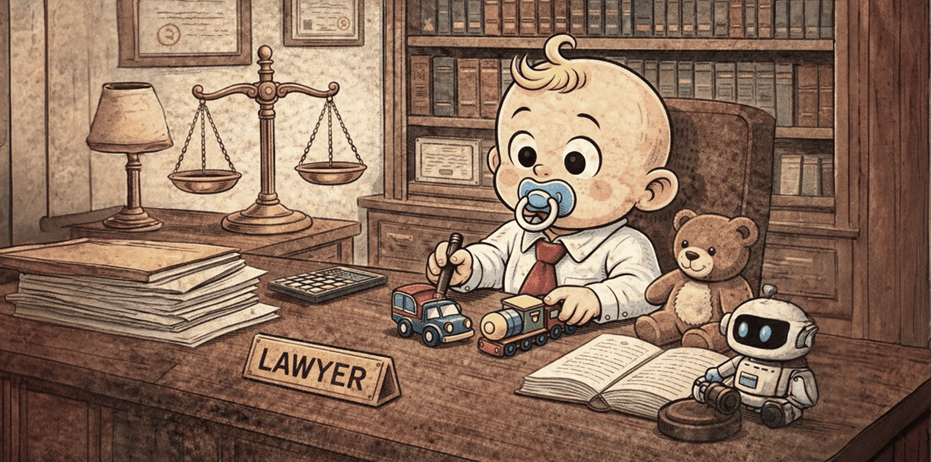
AI Is Breaking the Corporate Learning Model
IN ONE SENTENCE
If AI does the formative work instead of beginners, who will become an expert tomorrow?
THE OBSERVATION
For 4,000 years, professional knowledge has been transmitted through apprenticeship: a junior does repetitive work under a senior's supervision, gets corrected, and gradually absorbs their mentor's expertise. This is how lawyers, consultants, financial analysts, and developers have always been trained.
This summer, according to Mollick, that chain broke. Juniors are using AI for everything; not to learn, but to deliver. They don't want to show their gaps in a competitive job market. Meanwhile, managers prefer delegating to AI rather than to an intern who might make mistakes. The training pipeline has disconnected from both sides.
WHAT YOU NEED TO UNDERSTAND
Repetitive work wasn't useless
Writing the same type of memo 50 times wasn't pointless torture. It was the mechanism through which a junior absorbed quality standards, implicit expectations, and their mentor's judgment. The BCG study confirmed by Mollick shows that juniors who simply submit AI responses without adding their own thinking get decent results but learn nothing. They become intermediaries between AI and the client, not experts in the making.
Two generations of risk
The danger is twofold. In the short term, current juniors deliver faster but develop less real expertise. In the medium term, if no one builds competence, who will supervise AI when tasks become more complex? Today's seniors will eventually retire. If their successors never deeply learned the craft, the company loses its capacity for human judgment.
Sports solution
Mollick identifies one domain where expertise building works perfectly: sports. Repeated practice with a coach correcting in real time, exercises targeting weaknesses, structured progression. Companies must formalize what was implicit in traditional apprenticeship and create deliberate training paths where AI is a pedagogical tool, not a substitute.
WHAT THIS CHANGES FOR YOU
- Audit how your juniors actually use AI: are they producing or learning?
- Create formalized learning paths where repetitive work is deliberately maintained, even if AI could do it
- Train your managers in explicit mentoring: stop relying on the implicit learning that worked before
- Use AI as a tutor to accelerate learning, not as a crutch to avoid learning
The learning chain that has trained experts for millennia is breaking. Companies that don't react risk ending up with an entire generation of professionals who know how to use AI but don't deeply understand their craft. Rethinking training is urgent. Source: Ethan Mollick, Strange Loop Podcast (Sana Labs), June 2025.
.png)
.png)
.png)
.png)
.png)
.png)
.png)
.png)
.png)













.png)