
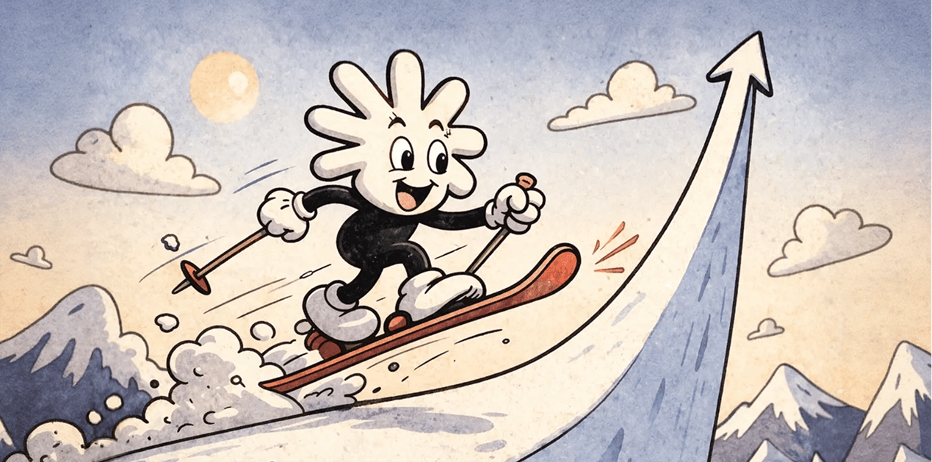
The End of the AI Exponential: What Every Leader Must Understand Now
IN ONE SENTENCE
Anthropic's CEO states that we are close to the end of the AI exponential: the moment when models reach and surpass human expert level in virtually all cognitive domains. Leaders who don't integrate this reality into their strategy risk being irreversibly left behind.
THE OBSERVATION
During his interview on the Dwarkesh Podcast in February 2026, Dario Amodei made an unambiguous observation: the exponential progression of AI follows the trajectory he anticipated back in 2017. Models have gone from high school level to university level, then to professional and doctoral level, all within a few years. In coding, they've already crossed that threshold.
What surprises him most? Not the speed of technical progress. But the fact that the world; leaders included; continues to operate as if nothing has changed. While public debates loop endlessly on the same topics, AI is silently redefining the fundamentals of every industry.
WHAT YOU NEED TO UNDERSTAND
The "Big Blob of Compute" hypothesis
As early as 2017, Amodei formalized a simple thesis: only a few factors truly matter in AI progression. Raw compute power, the quantity and quality of data, training duration, and an objective function that can scale indefinitely. All the clever technical tricks and ingenious methods take a back seat to these fundamentals. This hypothesis, confirmed year after year, remains the backbone of current progress.
RL scaling: the second wave
Beyond classical pre-training, Reinforcement Learning (RL) now follows the same scaling laws. Model performance on varied tasks progresses log-linearly with RL training time. It's no longer limited to math competitions; it's a generalized competence increase progressively touching all professional domains.
One to three years to a "country of geniuses in a datacenter"
Amodei estimates a 90% probability of reaching, within 10 years, what he calls a "country of geniuses in a data center"; AI systems capable of matching the best human experts in all domains. His personal conviction leans toward a 1 to 3-year horizon. The question is no longer whether this will happen, but exactly when.
The gap between technical capability and awareness
The greatest risk according to Amodei isn't technical. It's the gap between the speed of progress and the slowness of collective awareness. Companies waiting for clearer signals before acting will find themselves facing a change already accomplished. The time for passive monitoring is over.
WHAT THIS CHANGES FOR YOU
- Integrate the hypothesis of expert-level AI into your strategic planning at 12-24 months. Stop planning based on current capabilities; plan based on the progression trajectory.
- Identify the cognitive processes in your organization that will be automated first: data analysis, writing, code, document research. Launch pilots now.
- Train your leadership teams to understand scaling laws and their implications. AI literacy at the C-suite level is no longer optional: it's a strategic survival imperative.
- Don't confuse slow adoption with absence of disruption. The economic diffusion of AI is fast: much faster than any previous technology: even if it's not instantaneous.
We are not at the beginning of a technological revolution. We are approaching its climax. Dario Amodei says it without hesitation: the end of the exponential is in sight, and companies that aren't actively preparing for this tipping point will be the first to suffer the consequences. The time to act is not tomorrow: it's now.
.png)
.png)
.png)
.png)
.png)
.png)
.png)
.png)
.png)













.png)