

From Occasional to Permanent: Agents Change the Energy Equation
IN ONE SENTENCE
An AI tool you query occasionally is manageable. An autonomous agent working continuously is a permanent load on infrastructure, and it fundamentally changes the cost equation.
THE OBSERVATION
At UNFAIR, we build agent systems that run in production. The difference between "asking a model a question" and "deploying an agent that orchestrates tasks 24/7" isn't incremental; it's structural.
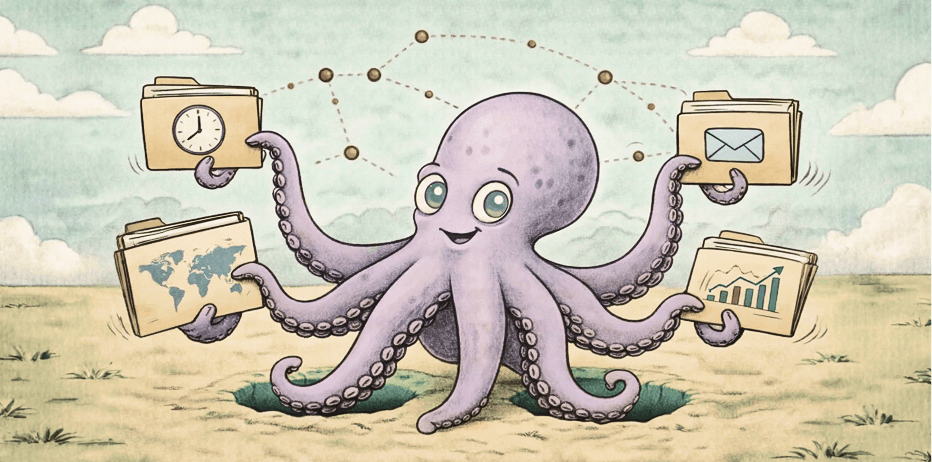
A conversational exchange is a brief request: the model calculates, responds, then the connection closes. A production agent is a process that loops continuously: it monitors, analyzes, decides, executes, verifies, and starts over. Multiply that by several agents coordinating with each other, and compute consumption explodes.
WHAT YOU NEED TO UNDERSTAND
This shift has direct consequences for any company investing in AI:
Occasional use = predictable, bounded cost
You control the volume of requests; you control the bill.
Continuous use (agents) = variable, growing cost
Agents self-feed on requests. Consumption depends on the work's complexity, not your original intent. A poorly calibrated agent can generate thousands of requests for a simple task.
WHAT THIS CHANGES FOR YOU
- Before deploying an agent, model its cost under continuous operation, not just its per-task unit cost.
- Segment your models: reserve powerful models for critical decisions, and delegate monitoring and sorting to compact models.
- Implement loop control mechanisms: token limits per cycle, escalation thresholds, conditional stops.
An agent is not an improved chatbot. It's a regime change. Shift from "how much does a question cost" to "how much does an hour of operation cost." It's the only way to stay in control.
.png)
.png)
.png)
.png)
.png)
.png)
.png)
.png)
.png)





























.png)